
The Vanishing Point
When every line points toward the same objective, the picture becomes clear.

I’ve never been a great artist. Fortunately, in military field sketching, the purpose isn’t to create art. It’s to create a shared understanding.
When I was first on a Recon team, in the days before we had the capability to rapidly send images and video, I got very good at producing a sketch detailed enough for an assault force to plan from. The sketch had to show the buildings, roads, obstacles, terrain, fighting positions, and likely avenues of approach. More importantly, it had to show how those things related to each other. (Special Operations teams still use field sketching, because it works)
That requires perspective.
In a one-point perspective sketch, receding parallel lines converge at a single location on the horizon: the vanishing point. Roads narrow toward it. Buildings diminish toward it. Fences, walls, and every parallel feature follows the same rules.
The vanishing point makes the picture make sense.
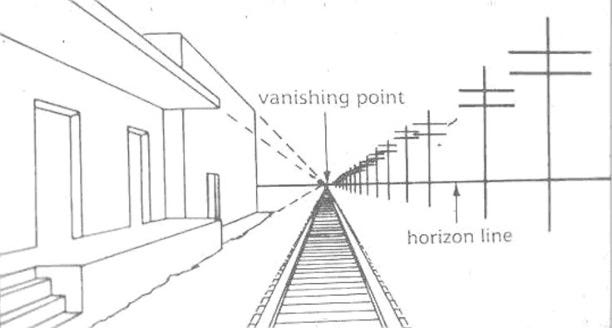
Without a consistent vanishing point, the individual objects may be recognizable, but they won’t fit together. Buildings lean in different directions. Roads widen as they move away. Distance becomes impossible to judge. The sketch looks childish because every part exists in its own reality.
That’s more than just an artistic problem when someone has to use the sketch to plan an assault.
A bad sketch can create confusion, while a good sketch creates shared understanding.
The War of Life works much the same way.
Most of us don’t lack activity. We lack alignment.
We work hard at our jobs, pursue physical goals, start projects, read books, attend meetings, make commitments, and keep the alligators closest to the boat at bay. Each action makes sense when viewed by itself. But step back and look at the full picture, and the lines might be running in completely different directions.
Your career points one way, your calendar points another, and your habits point somewhere else.
You say your family matters most, but they get whatever time remains. You say health is important but sacrifice it to work. You want to write a book, build a business, earn a promotion, or prepare for retirement, yet your daily actions provide little evidence that these are the objectives.
The result is a life filled with recognizable pieces that don’t form a coherent picture.
Your effort doesn’t converge at a strategic end state.
A clear strategic goal acts like a vanishing point. It gives direction to everything in the foreground.
If the objective is to build a business, studying, learning, networking, and improving your understanding of the market should all move toward that point.
If the objective is to complete a difficult endurance event, your training, nutrition, sleep, and recovery should support the same outcome.
This doesn’t mean every action must directly advance one goal. Life contains multiple Lines of Effort, and some work simply maintains the ground you’ve already taken. But your major commitments should fit within a larger perspective. They should reinforce one another rather than compete with each other.
Here is a test:
If someone studied your calendar, habits, and spending without knowing your strategic goal, could they tell where your life is headed?
Once your vanishing point is established, decisions become easier.
An opportunity either moves you toward coherence or away from it. A commitment either supports the objective or pulls an important LOE in another direction. A habit either makes the desired end state more likely or holds the status quo.
The important parts of your life should point toward the same place on the horizon.
Choose your objective. Place it clearly in the distance. Then examine the lines of effort running through your life: your work, health, relationships, time, attention, and resources.
Do they converge?
If not, you might not need to work harder. You may need to redraw the picture.
In the War of Life, when lines converge, you have an azimuth. When they don’t, every effort brings confusion.
Until next week, Charlie Mike!
John - Your arms dealer for the war of life


“If someone studied your calendar, habits, and spending without knowing your strategic goal, could they tell where your life is headed?”
Great stuff, John! Where we invest our time and money and effort reveals who we REALLY are. Makes me think of Stephen Covey’s 4-quadrant time mgmt system covered in his book “First things first.”