
Clarity:
The first step in Getting Better at Getting Better
If you missed last week’s post, this is the second in an 8-post series. Last week was an introduction to a framework I have developed over the years. For the next 7 weeks we will cover the 7-C’s of Walking Point
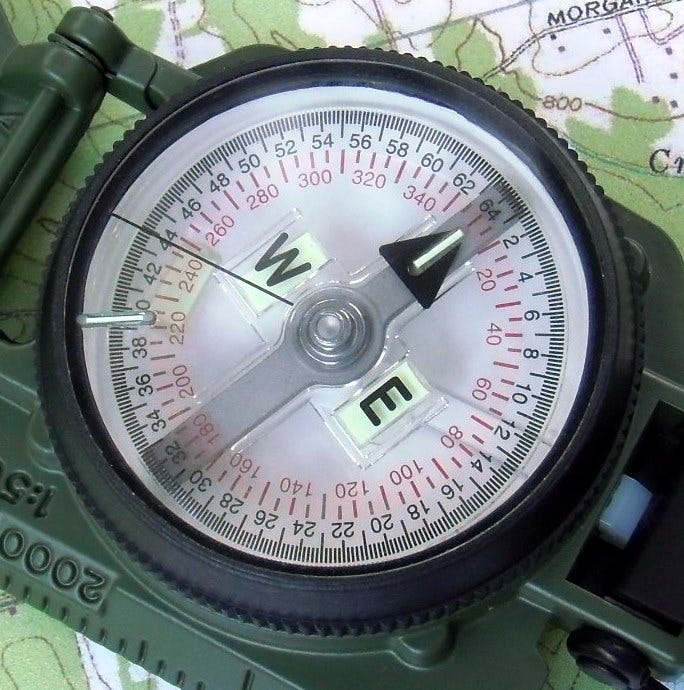
Often, we mistake motion for progress.
If you head out into the woods and start walking without a compass heading or landmarks in the distance to use for reference, you will get turned around.
That is why in survival situations, one of the commonly used mnemonic devices is STOP: Stop, Take inventory, Orient yourself, and Plan.
All four of these tasks involve staying where you are until you are ready to move.
But, as I mentioned last week, we are born with the need for speed. From crawling, to walking, to running, to biking, to driving a car, we can’t wait to go.
When we’re young, direction is handled for us. Parents, coaches, teachers—they point the way. And if we’re lucky, their compass points toward something good. But somewhere along the way, those voices fade, and we replace them with others: coworkers, friends, influencers, bosses. Some mean well. Some don’t. Either way, we start moving in whichever direction feels easy, following whoever seems confident, hoping that if we walk their path, we’ll end up where we’re supposed to be.
But the truth is, many of us are patrolling in the fog—moving fast, but without a map, a compass, or a destination. We follow momentum, not mission. We confuse activity for purpose. And every mile we travel without clarity just increases the distance from where we were supposed to go.
Then, when we realize that we are lost in the woods, we often look for someone to guide us out. And there is no shortage of people who are happy to tell you to follow them. Their plan, their program, their path.
But here is the thing: while they may lead you somewhere better than where you are, they can only lead you to their destination. Not yours.
I didn’t just make this up. In the Arthurian legend, when the Holy Grail appeared before the Knights of the Round Table, each decided that they must enter the forest where it seemed darkest to them. To follow another was shameful. Each needed to blaze his own path. Each needed to Walk Point.
That’s why the first “C” in the Seven C’s of Walking Point is Clarity.
Clarity begins with a simple question: Where are you trying to go?
Not what you want to have, not what you want to look like, but who you want to become.
When I teach planning, I lean on the military framework because it applies to life perfectly. There are three levels of war—and three levels of planning:
Strategic – The overarching goal. The “why.” For the Allies in WWII, it was to defeat the Axis Powers and ensure they could never wage war again. That clarity of purpose guided everything else.
Operational – The “how.” The bridges to cross, the hills to take, the major objectives required to move toward the strategic goal. In life, this might be building a business, writing a book, or raising a family grounded in your values.
Tactical – The “what now.” The daily patrols, the actions, the repetitions you can check off today that move you ever slightly closer to your objective.
Strategic clarity gives meaning to operational goals. Operational goals shape tactical decisions. And tactical execution—those little daily victories—keeps the entire campaign alive.
You may think you can’t see that far into the future. That’s fine. You don’t need a perfect plan; you need a direction of travel. Plant your strategic flag as far out as you can see. Ask:
Who do I want to be?
What do I want to be capable of?
What do I want said about me when I’m gone?
Even if those answers change, you’ll still be moving with purpose. The compass doesn’t care if the weather shifts; it still points north. And more importantly, you will be Walking Point.
Execution (Find Your Azimuth)
Write your Strategic Aim: who you want to become and why.
Define your Operational Objectives: 3 measurable mid-long range goals that lead toward it.
Identify your Tactical Mission: daily actions that can be marked ✅ or ❌.
Conduct a Weekly AAR: Did my actions move me closer to the flag?
Don’t just move. Move with clarity. The fog will lift once you stop following and start navigating. Until next week,
Move with mission, and Start Walking Point!
John
Thank you for reading. Please share this with a friend who needs it.
I’d love to hear your thoughts:

If you've read my book, Tough Rugged Bastards, thank you for helping make it a bestseller. I would appreciate it if you would leave an honest review on Amazon. Thanks!
If you enjoy this newsletter and also enjoy rucking, or are interested in starting and don’t mind the occasional F-bomb, you may want to check out my other newsletter, Ruck The F Up at RTFU.substack.com


Well written. I notice when I’m out backpacking and bushwhacking I have a tendency to follow a contour line or, horrors, descend when I should be getting my lazy butt up the mountain not across or down. I need to focus on my objective to keep myself from unconsciously taking the easier path. Sorry to say I’m not one of the Tough Bastards you describe so well in your book. Great book BTW.
Outstanding